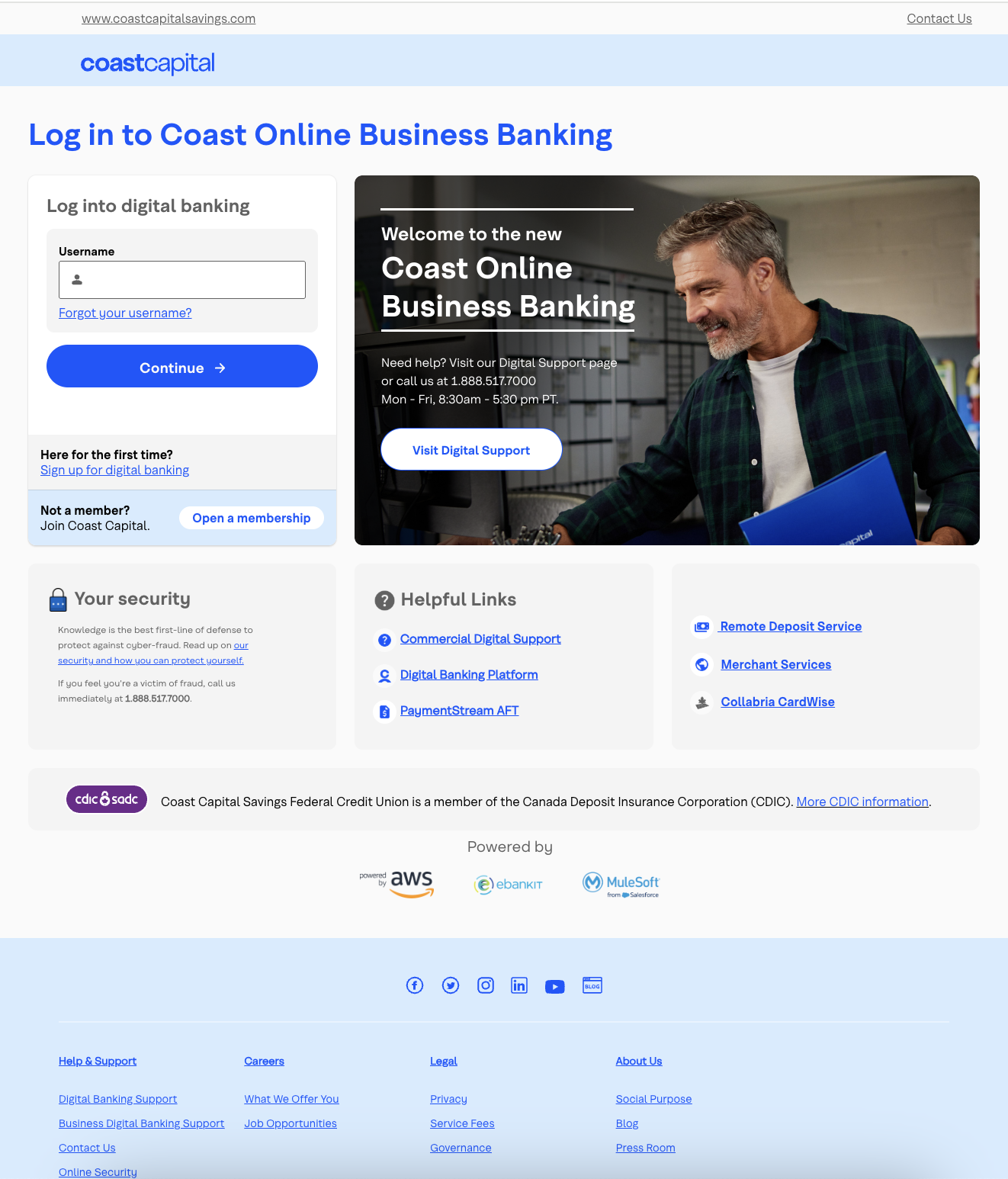
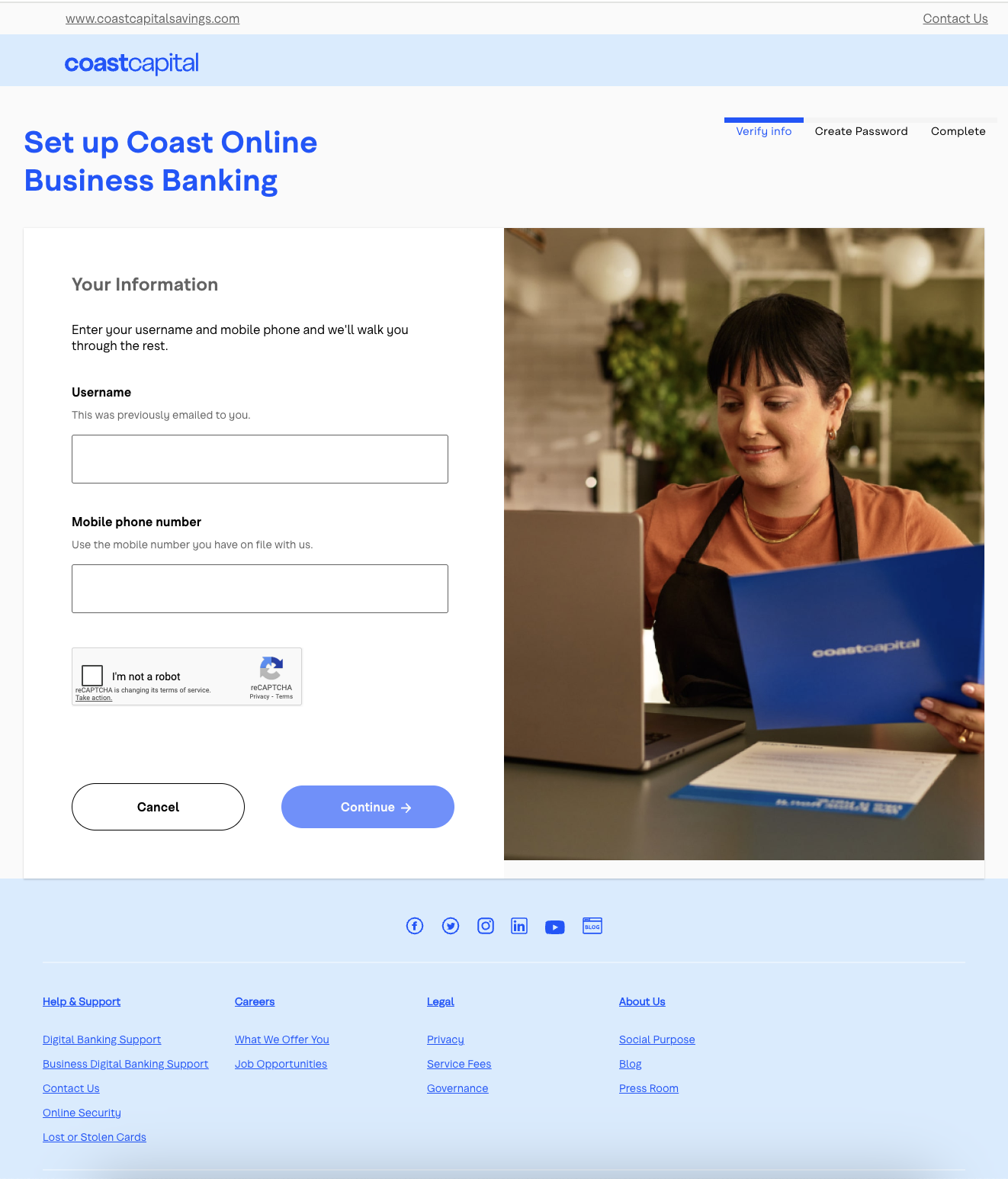
Modernizing the Commercial Banking Platform

Streamlining Complex & High-value Business Operations
Executive TL;DR
Context: Coast Capital Savings digital banking ecosystem across Web & Mobile.
The Goal: Modernize high-complexity commercial digital banking journeys onto a single, unified codebase serving personal, SMB, and enterprise commercial members.
My Role: Director / Design Leader—Architected multi-user permission hierarchies, complex bulk approval workflows, and unified design tokenization across personal and enterprise contexts.
The Resolution: Normalizing transaction and heavy data patterns (API orchestration, pagination, high account density) across shared codebases while ensuring zero downtime or regression for personal banking users.
The Impact: Modernized enterprise operations across personal and commercial segments while expanding the global UI system footprint by only 5%, achieving 0% downtime or personal banking regression during legacy migration.
0% downtime
Downtime & Retail Impact During Codebase Integration
5% inflation
System Footprint Growth (Minimal Component Inflation)
400K+ upgrades
Total Ecosystem Members Supported Across Platform
1000’s accounts
Account Scalability Handled per Enterprise Client
🎯 The Want - Strategic Context & Objectives
Commercial members require high-velocity cash movement, granular risk management, and multi-user governance.
To modernize the platform without maintaining expensive parallel software platforms, the business mandated deploying commercial capabilities onto the exact same codebase as retail personal banking.
Core Strategic Mandates:
Multi-Persona Authorization: Accommodate single-owner workflows alongside complex corporate delegate structures with multi-tier approval chains.
Scalable Data Density: Support financial management across portfolios ranging from single accounts to large corporations managing 1,000+ accounts seamlessly.
Codebase & Design System Cohesion: Normalize personal banking components to handle heavy B2B data loads without splitting into fragmented visual systems.
Legacy Migration (C1 Platform): Transition long-standing business members off the legacy "C1" platform without breaking ingrained user mental models or causing operational friction.
🚧 The Obstacle - Systemic & Technical Challenges
Shared Codebase & Component Strain: Extending retail component patterns to handle extreme commercial requirements—such as multi-line bulk payments, complex pagination, and deep account hierarchies—risked breaking the personal banking UX.
Data Orchestration & Performance: High-density pages with 1,000+ accounts created severe API payload and rendering bottlenecks that required new visual loading and pagination patterns.
Learned Behavior & Legacy Friction: Legacy C1 users viewed outdated workflows as "desirable features" due to muscle memory. Overcoming this required bridging legacy paradigms with modern operational efficiency.
Out-of-the-Box (OOTB) Capability Integration: Vendors provided OOTB features (like user profile avatars) that were helpful for consumer apps but proved intrusive in formal corporate environments if not thoughtfully contextualized.
⚡ The Resolution - Architecture, Systems & Design Execution
Key Architectural Approaches
Contextual Tokenization & Variants: Retained foundational personal banking elements while engineering high-density spin-off variants for heavy data tables, bulk transaction processing, and file downloads.
Backward-Compatible Component Architecture: Every shared component built for B2B was designed with personal banking scalability in mind, merging backwards into the primary design system so all audiences benefited.
Delegate & Approval Hierarchies: Designed modular approval matrix patterns allowing administrators to set granular permissioning for delegates, custom approval thresholds, and batch transaction releases.
Graceful OOTB Feature Adaptation: Refined vendor-provided capabilities (e.g., profile pictures and metadata tags) to render as optional convenience layers that never impeded core transactional velocity.
💡 Product Evolution
Architecting for enterprise B2B scale within a consumer-grade infrastructure. Building a commercial platform on a shared consumer codebase presents an inherent architectural tension between consumer simplicity and enterprise density. By treating B2B patterns as high-density extensions of our base design system rather than an isolated fork, we maintained a single codebase. This decision minimized ongoing engineering overhead, unlocked instant platform updates across all member segments, and established a scalable blueprint for unified financial software architecture.